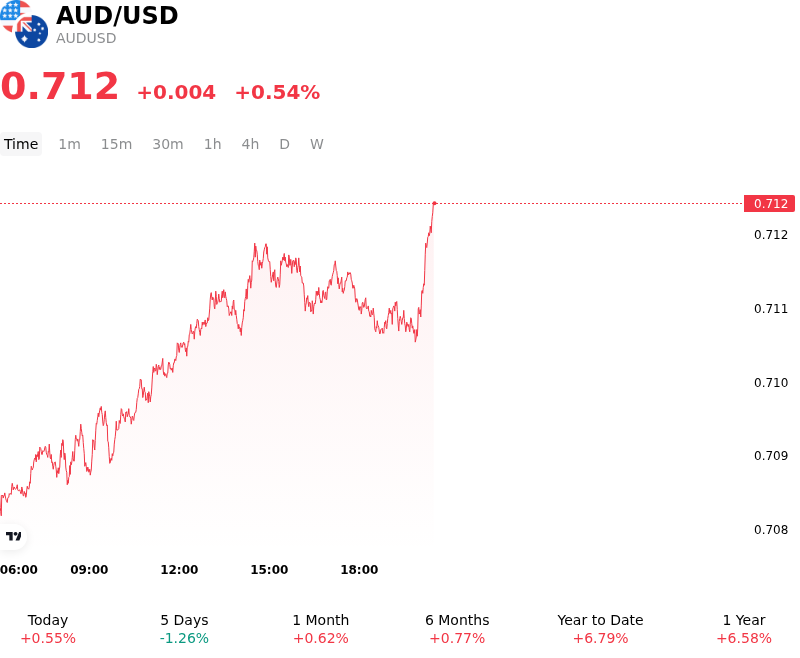
AUD/USD (AUDUSD) is up 0.54% at Sep 17 08:30(ET), now at $0.71238, with a 7-day down of 0.44%.
What is driving AUD/USD (AUDUSD)’s stock price up today?
The upward movement in the Australian dollar against the US dollar was primarily driven by diverging monetary policy expectations and widening sovereign yield differentials favoring Australia. Money markets have increasingly priced in a hawkish outcome for the Reserve Bank of Australia at its upcoming policy meeting, supported by sticky core inflation and resilient domestic economic activity data. With Australian trimmed mean inflation remaining persistently above the central bank's target band and recent economic growth figures surpassing consensus estimates, institutional investors pulled forward expectations for an additional cash rate hike. This hawkish repricing pushed Australian sovereign bond yields higher relative to their US counterparts, expanding short-term interest rate differentials in favor of the base currency and attracting carry-oriented capital flows into the Australian dollar.
Conversely, the US dollar faced headwinds as market participants recalibrated Federal Reserve policy expectations, with easing US Treasury yields dampening demand for the greenback. Softening US yields diminished the dollar's relative rate advantage, creating an asymmetric policy backdrop where the Reserve Bank of Australia tilts hawkish while the Federal Reserve trends toward monetary easing. This environment was further supported by a firm risk-on tone across global financial markets, which historically benefits high-beta, commodity-linked currencies. Improved risk appetite and firming prices for key industrial commodities provided additional tailwinds, prompting institutional investors to reallocate capital away from safe-haven greenback holdings toward growth-sensitive currency assets.
From a global macro strategy perspective, the strength in the Australian dollar relative to the greenback appears well supported by underlying interest rate differentials and monetary policy divergence rather than purely short-term technical factors. Nevertheless, institutional investors continue to monitor key downside risks, including potential shifts in global trade momentum, commodity price volatility, and upcoming inflation prints, which could alter central bank policy trajectories and influence the pair's broader trend.
Technical Analysis of AUD/USD (AUDUSD)
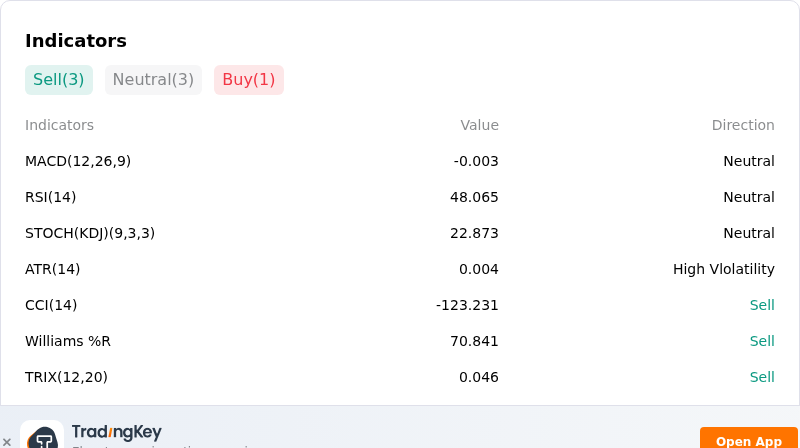
Technically, AUD/USD (AUDUSD) shows a MACD (12,26,9) value of -0.003, indicating a neutral signal. The RSI at 47.787 suggests neutral condition and the Williams %R at 71.885 suggests sell condition. Please monitor closely.
More details about AUD/USD (AUDUSD)
Recent Events and Risks:
- Federal Reserve Hawkish Policy Signals: Recent hawkish Federal Reserve rate action and guidance, driven by persistent US inflation readings, have spurred a rally in the US Dollar and compressed Australia-US yield spreads, placing immediate downside pressure on AUDUSD.
- Domestic Growth Headwinds and Weakening Sentiment: Australian business sentiment indicators falling into negative territory alongside deteriorating consumer confidence and rising underemployment concerns have raised economic growth risks, undercutting fundamental support for the Australian Dollar.
- Geopolitical Supply Shocks and Risk-Off Capital Flows: Escalating Middle East geopolitical tensions and elevated crude oil prices have driven global equity markets into a risk-off posture, dampening market appetite for high-beta, commodity-linked currencies like the AUD.
- Bearish Options Skew and Technical Breakdown Exposure: Derivatives positioning shows an accelerating downside bias, with short-term risk reversals hitting multi-week bearish extremes while spot AUDUSD trades precariously near key moving average support levels.
Find out more